
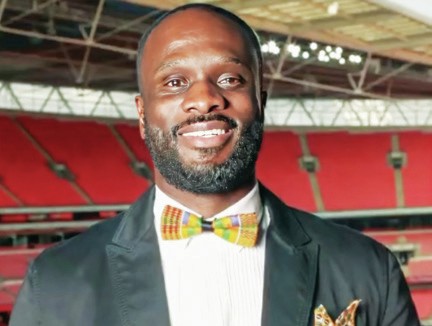
By Francis Duku – Former Non-League defender and founder of The Sports Circle
Football is uniquely positioned to have a tangible impact on our lives – especially when it comes to mental health.
Just think how many people come into contact with a club each week. Be it the first team on a Saturday or the youth sides throughout the week, a Non-League football team can reach far and wide.
The Government’s men’s health strategy – launched in October – talked about Premier League clubs being able to get the message across to men about the importance of their mental health. And Non-League clubs can have a huge impact too.
This is not to say women’s mental health isn’t just as important. It absolutely is. But we know there is a real issue among some men acknowledging and reaching out for help. The stats around male suicide are frightening again.
Ambassador
I’m proud to have recently been appointed as the first ambassador for the fantastic mental health charity Westmeria Counselling Services.
Bromley-based, they have a really unique model to make accessing the right support and a qualified pathway as affordable as possible.
They run a college to train counsellors and part of that enables them to offer subsidised mental health support for those in need.
They have 250 clients each week, yet only 20 per cent of those are men!
That’s where I hope to help raise awareness of the great work they do and encourage more men to use the services if they need them.
We want to help people understand it’s not a weakness to seek help, as some may think it is. It is most definitely a strength that could make a massive difference to someone’s life.

Thrive
It’s also about people realising we all have mental health – it can be good as well as bad. It’s part of your whole body, your whole ecosystem. It is how you exist, how you survive and then go on to thrive.
Can we help people to think about this as a way to go on to thrive?
In simple terms, think about if you’re in a good mood versus a bad mood and the difference in how you behave, interact and perform.
If you can train yourself to do the things that will help keep you in a good mood and keep you positive, it’d make a massive difference to your life.
The same goes for players as well and how they perform. We need to make football’s environment as open as possible for young footballers to have the confidence to speak up when they are struggling.
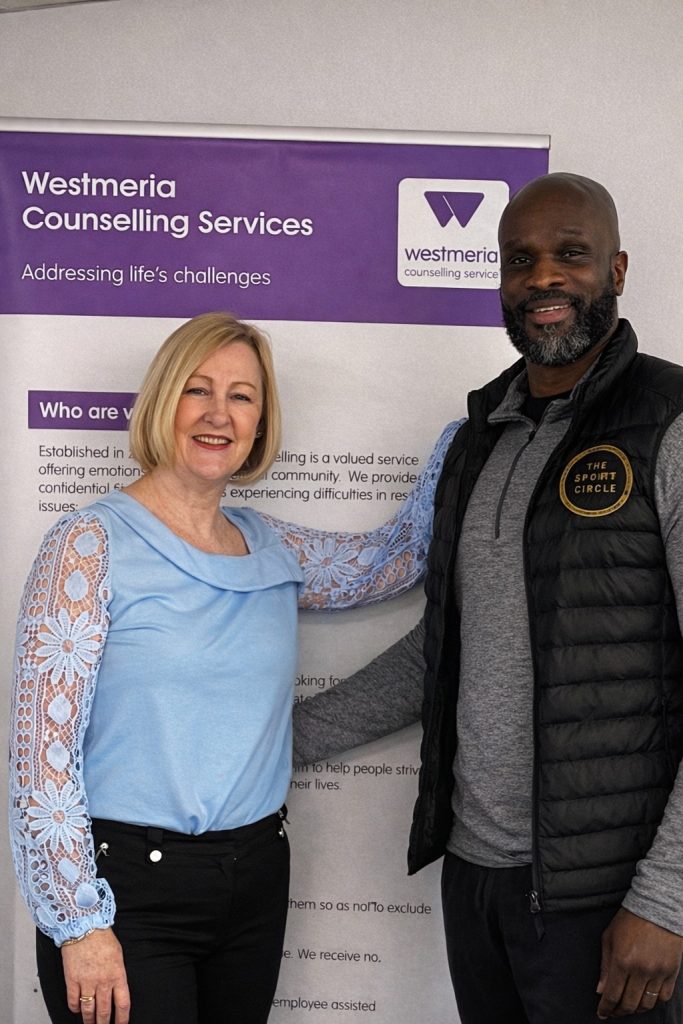
Sue Doughty, founder of Westmeria with Francis Duku CEO of Non-League Day and founder of The Sports Circle
Strength
I’ve had this discussion with friends over the years. If you really think about it, football, like competitive sport as a whole, thrives on identifying weakness and exploiting it.
That’s not just the mental side we’re talking about. But, for example, the left winger is much quicker than the right-back.
So let’s make sure we get the ball to the left winger. Or the defender is not very good in the air, let’s put balls in aerially. It’s just the nature of the sport.
I think that’s part of what permeates through – do not show weakness. It’s an attitude of let’s go and show that we’re strong and there’s nothing wrong.
Because we don’t want to be seen as the weak link. But this goes far beyond sport because we’re talking about people, loss of lives and things like that. It’s far more serious.
Powerful experience
I’ve also learned from some good friends who have first-hand experience of the value of mental health support.
Staines Town fans will remember Adrian Toppin scoring against Stockport County in the FA Cup.
He’s a good friend who I played with at Dulwich in my younger days and then Staines further down the line.
He had a real, powerful experience because his day job as a firefighter meant he was a first responder at Grenfell, so he was literally pulling people out.
Soon after that, he also lost his mum and found himself in need of real, real help.
He learned to heal himself through trauma informed support, training and spirituality. He now does work in the mental health space, trying to support people and find the better path they can also benefit from, and can be found on Instagram as Keep It 100 Life Coaching (@keepit100lc)
Full potential
He is just one example of someone who maybe people wouldn’t have thought would need help, as a footballer or a firefighter.
But his experiences pushed him to that place and this is something that can happen to all of us.
Someone else I have been speaking to a fair bit about mental health recently is Myles Anderson, at Rayners Lane FC.
His football career has seen him gain experience at the likes of Aberdeen, Blackburn, Exeter City and AC Monza and Chievo Verona in Italy before playing in Non-League for the likes of Braintree, Beaconsfield and now Heybridge Swifts.
He works as a Mental Performance & Life Coach working with players and clubs from Non-League up to as high as the Championship, and runs a programme called Unleash the Player to help players look at some of the mental barriers which they may have to unleashing their full potential. He can be found at www.unleashtheplayer.com.
All these things are projects we’re supporting and trying to bring to more people’s attention with the work of The Sports Circle to signpost the options of help that are out there if you feel you need the support. It all starts with awareness.
Some men are better at masking issues than others. But the message is: you shouldn’t have to pretend. You should be able to get the help you need when you need it, because it is that important.
Follow The Sports Circle on X: @sportscircleuk
Website: www.thesportscircle.co.uk

READ MORE: Mark Carruthers: How Hebburn Town went from brink of collapse to Northern Premier League contenders


Non-League Paper
TOP NUMBER NINES ARE A DYING BREED

Non-League Paper
A COMMUNITY AN ATTRACTIVE MAKES CLUBS PROPOSITION

Non-League Paper
ELL’S DIAMONDS ARE SPARKLING

Featured
BT Calling

Dagenham & Redbridge
Dagenham & Redbridge boss Lewis Young wants to lead revival after relegation

Non-League Paper
Club allocations revealed: 2025-26 league line-ups unveiled
Follow us
Read our latest news on any of these social networks!



Tackle the News
- Sign Up for our weekly Non-League Newsletter