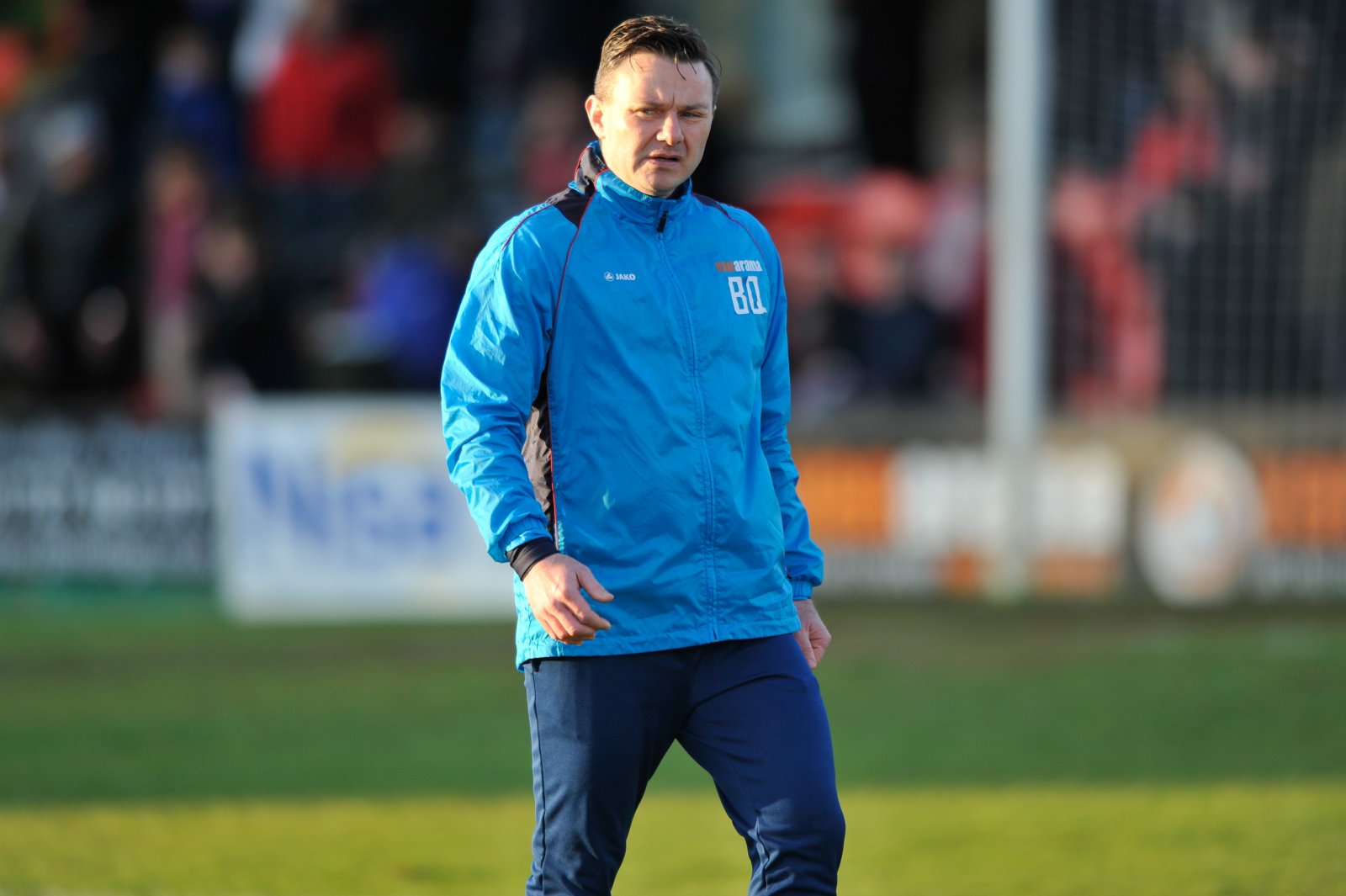
(EARLY SEASON DEPARTURE: Former Braintree Town boss Bradley Quinton)
By Nige Tassell
Autumn is a time of certainty. Leaves fall from trees. The days are as black as soot come tea-time. And football managers will forever hear the plop of P45s on doormats.
In the football world, autumn is a time of both reflection and projection. The season is three or so months old and has thus offered plenty for a club’s directors to chew over. The performances so far may already be enough to condemn a manager to his fate.
Even if his reign has been solid but unspectacular, the crystal ball in the boardroom may suggest he’s not the man to deliver much-needed success in the future. If both recent results and the long-term forecast fail to pass muster, he’s definitely down the job centre in the morning.
Non-League managers are as susceptible to the vagaries and whims of trigger-happy chairmen as much as their more famous counterparts further up the ladder. But what to some looks like impetuousness and impatience is, to other eyes, simply the harsh reality of a fast-moving, ever-changing sport.
Not that such behaviour is exclusively displayed during autumn. In the first two months of this season, four National League managers headed for the exit door, either voluntarily, involuntarily or – to use that evergreen, ambiguous euphemism – “by mutual consent”.
The latter explanation was offered when Bradley Quinton left Braintree Town in early October. As Anthony Johnson and Bernard Morley discovered at Salford City over the summer, Quinton found that success was no insulation against job security. Despite hauling Braintree out of the National League South in his first season as a manager, Quinton quickly found that even middle-distance longevity was an alien concept in his new line of work.
With the demise of manufacturing industries in the UK, there are very few jobs for life any more – and this, of course, is especially true of football management. Those at the tip of the pyramid, though, land on the safety mat that a chunky pay-off provides.
Pressure
When the Braintree hot seat was advertised following Quinton’s departure, the job description explained that the full-time wage was “up to £40,000 per annum, subject to experience”. This is, of course, comfortably better than the average annual salary, but is it adequate recompense for a position that demands the holder to almost exclusively devote every waking moment to, to be open all hours?
It’s also probably what a Premier League manager spends each year on suits, haircuts and fake tan. At the top table in Non-League, that amount represents mortgage repayments and food on the family table – and all with little guarantee that the salary will be in place for very long. A couple of years if they’re lucky.
This, of course, is real pressure – pressure that’s both professional and personal. Failure for a Premier League or Championship manager is little more than a dent in a reputation, a smudge on a CV. Their next mortgage payment isn’t in jeopardy. Their luxury homes will have been paid for in cash many moons ago.
And yet there’s no shortage of candidates whenever a Non-League managerial vacancy arises. The ambition to beat the odds is still there, even if turnover remains huge. The door marked ‘Exit’ is practically propped open on a permanent basis.
Of all the clubs I profiled in my book The Bottom Corner a couple of years ago, only two still have the same manager – Gavin Rose at Dulwich Hamlet and Darren Freeman at Lewes. This probably isn’t a coincidence. Both are clubs with the patience to play the long game, their eyes on a distant future, not an immediate horizon.
Of course, not many clubs have the luxury of being able to act this way. Margins are both fine and tight. Most have to live in the moment, their immediate aim not being to build and plan, but to merely survive.
Patience and pressure are infrequent bedfellows. It’s no wonder that chairmen have such itchy trigger figures.
Nige Tassell’s latest book – Butch Wilkins And The Sundance Kid: A Teenage Obsession With TV Sport – is out now, published by Arena Sport



Featured
BT Calling

Dagenham & Redbridge
Dagenham & Redbridge boss Lewis Young wants to lead revival after relegation

Non-League Paper
Club allocations revealed: 2025-26 league line-ups unveiled
Follow us
Read our latest news on any of these social networks!



Tackle the News
- Sign Up for our weekly Non-League Newsletter